

School website + management system
Ayyubi Public School -
Website & School Management System
A public school website and an admin portal the office runs on its own.
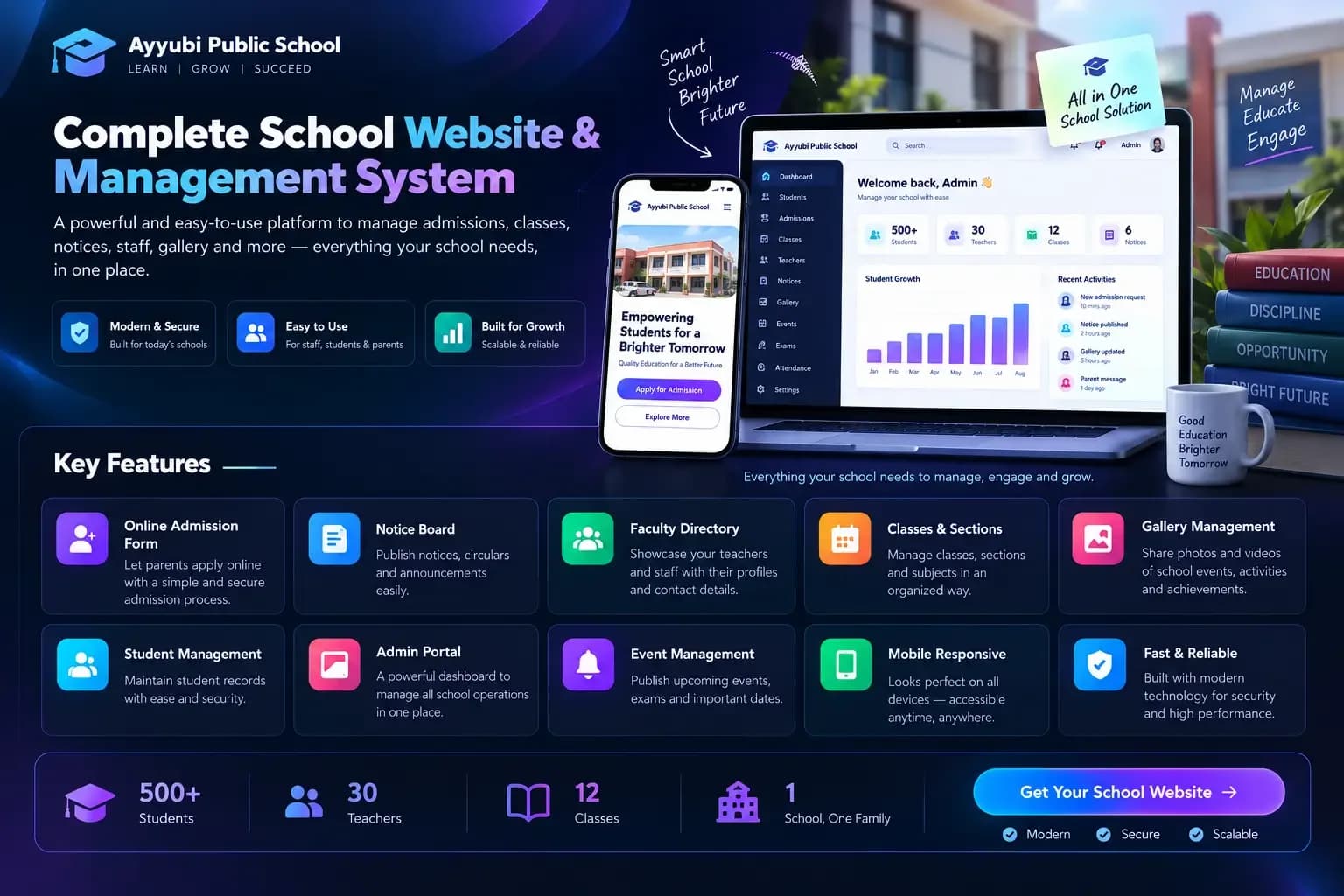
A complete school website and management system for a 500-student institution: online admissions, staff and class records, notices and a gallery, built on ASP.NET Core with a Next.js front end.
Run by the school
No developer for daily updates
01Summary
A complete website and management system for a school in Kushinagar, Uttar Pradesh, running classes 1 to 12 for more than 500 students with a faculty of 30. Parents get a public site with online admissions, notices and a gallery; office staff get an admin portal to run all of it themselves — no developer needed for day-to-day changes.
- Online admissions
- Staff-run admin portal
- Mobile-first for parents
02The Problem
Everything that touched a parent lived on paper in the office:
Enquiries, admission forms, notices and fee questions all arrived by phone or in person.
Admission applications meant a queue at the office counter.
Notices reached parents slowly, if at all.
Enquiries were scattered across personal phones and WhatsApp instead of one inbox.
Any website change would need a developer — the reason most school websites are abandoned in their first year.
03My Role & Scope
Design and development of both halves: the public site and the admin portal behind it.
- Public websiteHome, About, Principal's Message, Classes, Teachers, Facilities, Admission, Notices, Gallery and Contact.
- Admin portalOffice staff sign in and manage admissions, notices, faculty, gallery and class records themselves.
- Online admissionsAn application form that replaces the office-counter queue, with the current session clearly marked.
- NoticesPublish, edit and take down, with dates handled automatically, so announcements reach parents the same day.
- Image pipelineUploads resized and converted to WebP on the way in, so a phone photograph does not slow the page down.
- REST API backendASP.NET Core exposing a clean API, so the site and any future app share one source of truth.
04Architecture
The admin portal was designed first, around what the office already does each day, and the public site renders whatever the staff put into it.
Parents
Next.js front end
ASP.NET Core API
Admin portal
SQL Server
05Key Features
What the school and its parents use every day.
- Online admission formApplications arrive in one searchable admin list, marked read or handled.
- NoticeboardThe school publishes directly; announcements reach parents the same day.
- Faculty directoryAdd a teacher, upload a photo and set the display order — no developer needed.
- GalleryBulk upload from the admin side, with images re-encoded automatically.
- Classes & sectionsThe structure the rest of the site reads from, from class 1 to 12.
- Role-based accessThe principal, the office and the content editor each see only what they need.
- Mobile-firstBuilt for parents on phones, often on slow connections.
- Fast without redeploysPages cached and revalidated on a timer, so new notices appear without a rebuild.
06Engineering challenges & how I solved them
The decisions that decide whether a school website survives its first year.
Most school websites die in their first year+
Symptom: The sites that get abandoned are the ones where every change needs the developer.
Investigation: The office already had a daily routine — admissions, notices, staff changes, event photos — and the site had to fit it, not the other way round.
Fix: Inverted the brief: designed the admin portal first around the office's daily work, then built the public site to render whatever the staff put into it.
Photos uploaded by teachers, not designers+
Symptom: Full-size phone photographs would make the gallery slow for parents on mobile data.
Fix: An image pipeline that resizes and converts every upload to WebP automatically on the way in.
Fresh notices without redeploying+
Fix: Server-rendered Next.js pages cached and revalidated on a timer, so the site stays fast and a new notice appears without a redeploy.
Different people, different permissions+
Fix: JWT authentication with role-based authorisation, so the principal, office and content editor each see only their part of the portal.
Case study
Most school websites die in their first year
Problem
The sites that get abandoned are the ones where every change needs the developer.
Investigation
The office already had a daily routine — admissions, notices, staff changes, event photos — and the site had to fit it, not the other way round.
Solution
Inverted the brief: designed the admin portal first around the office's daily work, then built the public site to render whatever the staff put into it.
07Impact
What changed for the school office and for parents.
- Notices go up the day they are written.
- Admission enquiries arrive in one place instead of three phones.
- The gallery grows after every event without anyone sending the developer a file.
- The office runs the site on its own.
- Parents apply online instead of queuing at the office counter.
ASP.NET CoreREST APIEntity Framework CoreSQL ServerNext.jsReactTypeScriptTailwind CSSJWT & RBACImage processing (WebP)
Have a similar project?
Let's build something great together.
From shipping platforms to custom business tools — I can help turn your idea into reality.
- Free consultation
- Clear roadmap
- On-time delivery