
Here's something nobody told us in school: your degree is slowly losing its monopoly on your future. Not because degrees are useless — but because employers and clients have quietly started asking a different question. It's no longer just "Which college did you go to?" It's "What can you actually do?"
Across India, companies are increasingly hiring for skills over pedigree. Freelance clients care even less about your marksheet — they care whether you can build the thing, write the thing, or sell the thing. And that shift is the single biggest opportunity for anyone reading this: if you can pick up a high-income skill, you can earn well in 2026 without waiting for permission from anyone.
This isn't a "get rich quick" list. Every skill here takes real months of practice. But each one is learnable — a lot of it for free — and each one can genuinely pay more than many degree-required jobs. Let's get into the seven that are worth your time this year.
First — what actually makes a skill "high-income"?
A high-income skill has three things going for it:
- It solves an expensive problem. Businesses happily pay for more customers, better websites, cleaner data, or content that sells.
- It's in short supply. Lots of demand, not enough good people = higher pay.
- You can prove it without a degree. A portfolio, a live project, or results speak louder than a certificate.
Every skill below ticks all three. Pick one to start — the biggest mistake beginners make is trying to learn five at once and mastering none.
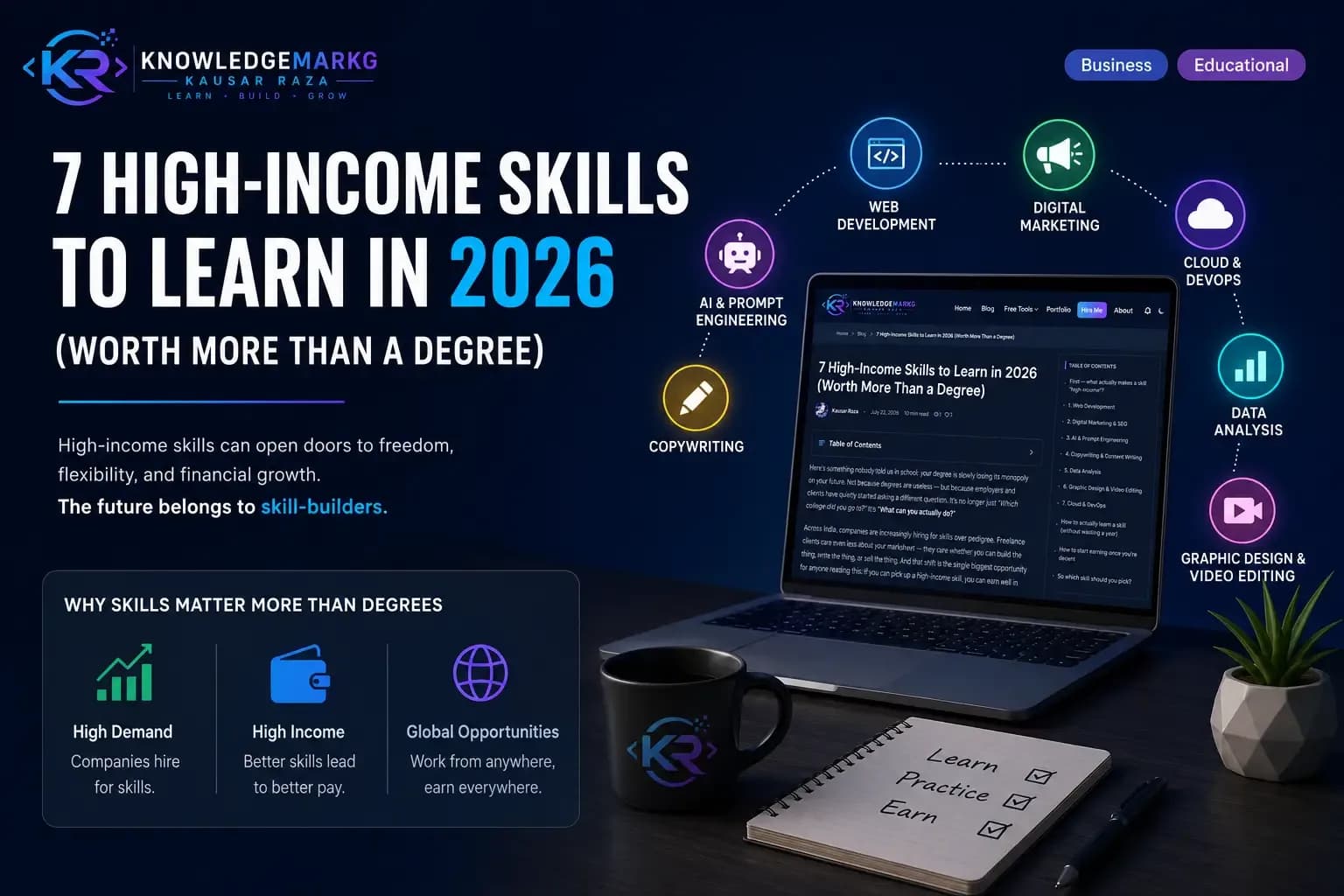
1. Web Development
If I had to bet on one skill for a beginner in 2026, it's this one. Every business — a clinic, a boutique, a coaching class, a startup — needs a website, and most of them are willing to pay for a good one. Web development is also one of the easiest high-income skills to prove: you build a site, you send the link, the client sees exactly what they're paying for.
Roughly what it pays: freelance projects commonly range from a few thousand rupees for a simple site to lakhs for bigger builds, and full-time developer salaries climb fast with experience. Time to job-ready: about 6–12 months of consistent practice.
How to start: learn HTML, CSS and JavaScript first, then a framework. We've laid out the entire path, step by step, in our Full Stack Web Developer Roadmap, and if you're not sure which language to begin with, read Best Programming Languages to Learn in 2026. Build three real projects, put them online, and you have a portfolio — which matters far more than any certificate.
Not ready to learn it yourself but need a website now? That's literally what we do — you can see our website plans on the Hire page. And once you can build sites, businesses that find us are the same kind of clients you'll earn from.
2. Digital Marketing & SEO
A business can have the best product in the world, but if nobody finds it, it doesn't matter. That's why digital marketing — SEO, ads, social media, email — is one of the most in-demand skills going into 2026. The best part: you can show results (traffic, leads, sales), and results are what get you paid and referred.
Roughly what it pays: solid monthly retainers once you can deliver results, and it scales beautifully as you take on more clients. Time to job-ready: 3–6 months to get dangerous, longer to master.
How to start: pick SEO first — it's the foundation. Learn how Google ranks pages, then practice on a free blog. Our guide on 10 Proven Digital Marketing Strategies is a great starting point, and you can practise for free with our Meta Tag Generator and Google SERP Preview tools to see exactly how a page shows up in search.
3. AI & Prompt Engineering
In 2026, "can you use AI well?" is quietly becoming a hiring question in itself. Knowing how to get real work done with tools like ChatGPT, Claude and others — writing sharp prompts, automating boring tasks, building simple AI workflows — is a skill businesses will pay for, because it saves them hours every single day.
Roughly what it pays: as a multiplier on everything else — an AI-fluent marketer, developer or writer simply out-earns one who isn't. Time to job-ready: weeks to get useful, ongoing to stay current.
How to start: pick one tool and use it daily for real tasks, not toys. Then learn to chain it into workflows. Our guide on AI Automation Tools to 10X Your Productivity is a practical place to begin. The trick isn't fancy prompts — it's knowing which tasks to hand to AI and which to keep yourself.
4. Copywriting & Content Writing
Words sell. A good sales page, email, or ad can be the difference between a business making money and burning it — which is why copywriting is one of the most underrated high-income skills. You don't need fancy tools or a degree; you need to understand people and practise a lot.
Roughly what it pays: per-project or per-word, and top copywriters charge more per page than many people earn in a week. Time to job-ready: 3–6 months of daily writing and studying good copy.
How to start: write every day, study ads and landing pages you like, and rewrite them. Keep your drafts tight — our free Word Counter helps you hit the right length, and the Case Converter is handy for clean headlines. If you want to grow an audience while you practise, 21 Ways to Keep Blog Readers Coming Back is worth a read.
5. Data Analysis
Every company is drowning in data and starving for people who can make sense of it. If you enjoy spotting patterns and telling a story with numbers, data analysis is a calm, well-paid, and surprisingly beginner-friendly path — especially with today's AI tools doing the heavy lifting.
Roughly what it pays: strong salaries even at entry level, and it opens doors into data science later. Time to job-ready: 6–9 months.
How to start: learn Excel deeply first (don't skip this), then SQL, then a bit of Python. Our Python for Beginners guide is a gentle on-ramp, and honestly, mastering spreadsheet shortcuts alone makes you faster than most — see our Top 50 Excel Shortcuts.
6. Graphic Design & Video Editing
Attention is the currency of the internet, and design is how you win it. Thumbnails, reels, logos, social posts, presentations — businesses and creators need a constant stream of visuals, and they'll happily pay someone who can deliver them quickly and consistently.
Roughly what it pays: per-design or monthly retainers, and video editors in particular are in huge demand thanks to short-form content. Time to job-ready: 2–4 months to start taking small jobs.
How to start: you don't need expensive software. Start with free tools and learn the fundamentals of layout, color and typography. Our post on 5 Amazing Canva Features shows how far you can get for free, and you can shrink your finished images for the web with our Image Compressor.
7. Cloud & DevOps
Behind every app and website is infrastructure that has to run reliably — and the people who manage it are among the best paid in tech. Cloud and DevOps has a slightly steeper learning curve, but that's exactly why it pays so well: fewer people push through it.
Roughly what it pays: among the highest in this list, and demand keeps climbing. Time to job-ready: 8–15 months, ideally after some coding basics.
How to start: get comfortable with the command line and Git, then learn containers. Our Docker Tutorial is a solid first step into this world. This one rewards patience — but the payoff is real.
How to actually learn a skill (without wasting a year)
The internet is full of "top 10 skills" lists and short on how to actually learn them. Here's the honest method that works:
- Pick one skill. Just one. Give it your full attention for 90 days.
- Learn the basics fast, then build. Don't watch 40 hours of tutorials. Learn just enough, then make something real. You learn 10x faster by building.
- Build in public. Share your projects, however rough. Feedback and visibility both compound.
- Make a portfolio. Three real projects beat any certificate. This is your proof.
- Start small, get paid. Your first client can be a local shop, a friend's business, or a tiny gig on a freelance site. Get that first "yes."
How to start earning once you're decent
You don't need to be an expert to earn — you need to be useful. Once you can deliver a basic result:
- Freelance platforms (Upwork, Fiverr) to land your first few gigs and reviews.
- Local businesses around you — many still don't have a website, decent social media, or clean content. Offer to fix it.
- Your own audience — a blog, a YouTube channel, or a simple portfolio site that shows what you can do.
Web development is especially beginner-friendly here, because the demand is everywhere and easy to see. If you want to understand the exact kind of client you'll be building for, read How to Take Your Small Business Online in 2026 — that's your future customer, described in their own words.
So which skill should you pick?
Quick gut-check:
- Love building things and want the clearest path to clients? → Web Development.
- Enjoy people, persuasion and results? → Digital Marketing or Copywriting.
- Like logic, patterns and numbers? → Data Analysis.
- Creative and visual? → Design & Video.
- Want the highest ceiling and don't mind a grind? → Cloud & DevOps.
- Whichever you pick — layer AI on top. It makes every other skill faster and more valuable.
The truth nobody puts in these lists
No skill pays you for learning it. It pays you for using it to solve someone's problem. The people who win aren't the ones who watched the most tutorials — they're the ones who picked one skill, built ugly first projects, got a little better every week, and had the guts to charge for it.
2026 is genuinely one of the best times in history to do this. The tools are mostly free, clients are everywhere, and the world has finally started paying for what you can do instead of where you studied.
So pick your one skill today. Start with the free guides and tools right here on this site — read the tutorials, use the free tools, and build your first project this week. And if along the way you'd rather have a professional website built for you than build one yourself, we're one message away.
Your degree opened one door. Your skills will open all the others. Go get one.

Join the conversation
No comments yet — be the first to share what you think.