


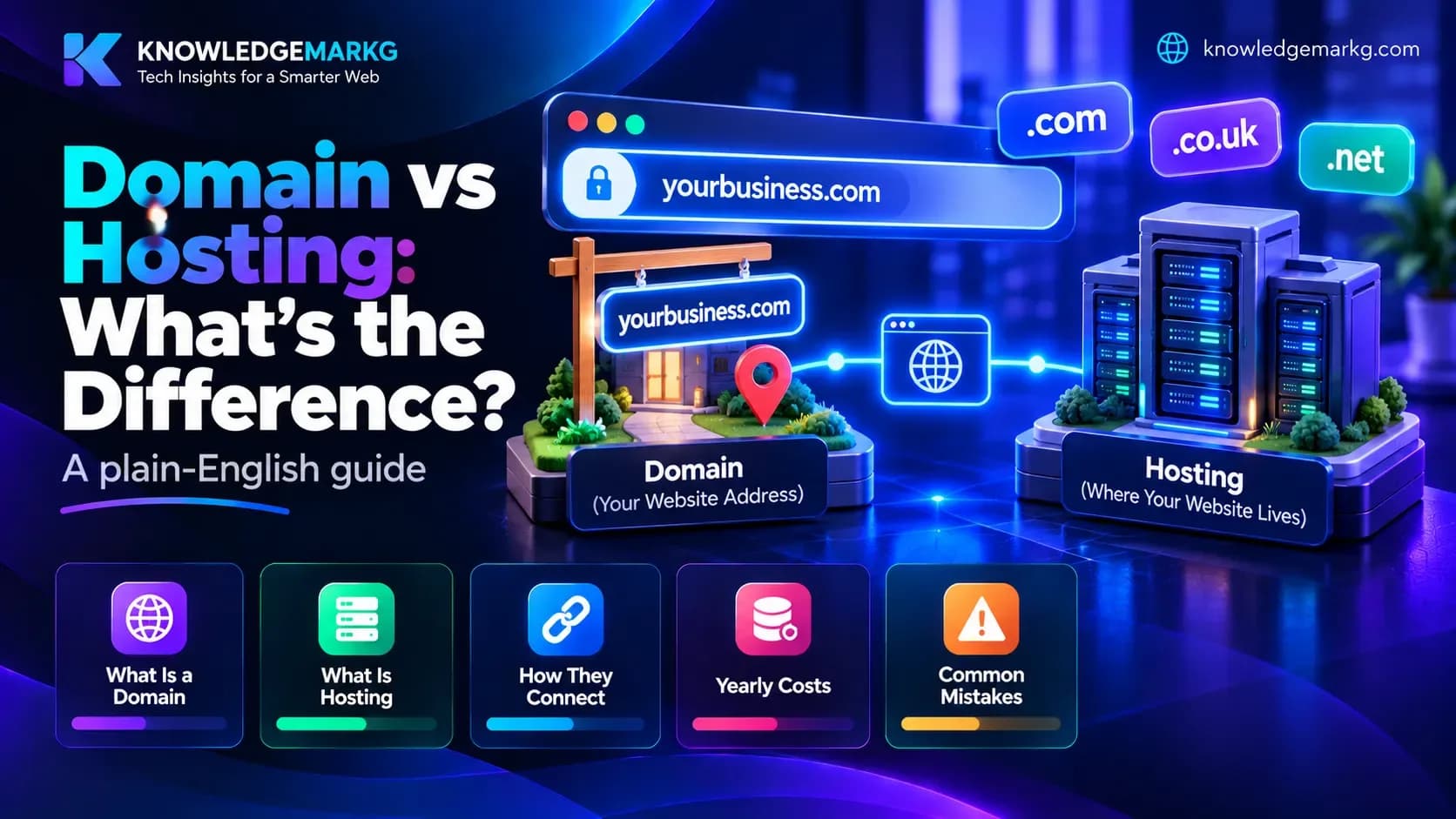
As soon as you start talking about a website, two words come up: domain and hosting. Most people are not sure what they are, whether they are the same thing, or whether they are paid once or every year.
I build websites for clients, and this question comes up in nearly every first conversation. So here it is without the jargon: what each one is, how they fit together, and what you should expect to pay.
What is a domain?
A domain is your website's address - knowledgemarkg.com, for example. It is what people type into a browser and what goes on your business card and van.
You do not buy a domain outright. You register it for a year (or several) at a time through a registrar, and renew it, rather like a licence. Stop renewing and, after a grace period, someone else can register it.
What is hosting?
If the domain is the address, hosting is the building at that address. Your website's files - pages, images, the database behind a shop or blog - have to live on a computer that is switched on and connected to the internet around the clock. That computer is a server, and renting space on one is hosting.
A domain without hosting is a sign with no shop behind it. Hosting without a domain is a shop with no address. A working website needs both.
How do they connect?
When someone types your domain, their browser needs to find out which server holds your site. That is done through DNS settings on the domain - usually by setting its nameservers to the ones your hosting company gives you, or adding a record that points at the server. It is a one-time setting; if a developer builds your site, they will normally do it for you.
Do I need hosting for my domain?
Only if you want a website at that address. You can register a domain on its own to reserve your name, to use it for email (many email providers only need the domain), or to redirect it to another site - none of those need web hosting. And some platforms, such as Squarespace, Wix and Shopify, include hosting in their plan, so you only bring the domain.
Can the domain and hosting be with different companies?
Yes, and it is often a good idea. Keeping the domain at a dedicated registrar means that if you ever change host, your address stays put and you simply point it at the new server.
How much do they cost per year? (UK and US, 2026)
Rough ranges, so you know what is normal:
- .com domain - about $10-20 (£8-15) a year at a mainstream registrar.
- .co.uk domain - about £5-12 a year.
- Basic shared hosting - about $3-10 (£3-8) a month; enough for a small business brochure site.
- Managed or cloud hosting - about $15-50 (£12-40) a month, for busier sites, shops, or when speed really matters.
- SSL certificate (the padlock) - free with almost every host now, via Let's Encrypt. You should not need to pay for one.
So a typical small business site costs somewhere between $60 and $150 a year to keep online on basic hosting. Building the site is a separate cost - see my pricing for what that involves - and ongoing care is covered in website maintenance: what it costs and what you get.
.com or a country domain?
- .com - if you serve customers internationally or want a brand people will type from memory. It is still the default people guess.
- .co.uk, .de, .fr and other country domains - if you trade in one country, they signal that you are local and can help with local trust.
If both are available and affordable, register both and redirect one to the other, so nobody else can take the near-identical name. Keep the name short, easy to say over the phone, and free of hyphens and numbers.
Five mistakes people make
1. Judging by the first-year price
Many registrars and hosts sell the first year cheaply and renew at several times the price. That is normal practice, but check the renewal price before you buy, not just the offer.
2. Letting the developer own the domain
The biggest one. Domain and hosting accounts should be in your name and under your email; give your developer access, but stay the owner. If the relationship ends, your business's address should not leave with them. It is the first of the ten questions to ask a web developer before hiring.
3. Turning off auto-renew
Expired domains are snapped up by resellers within days. Keep auto-renew on, with a card that will not expire, and an email address you actually read.
4. Choosing the cheapest hosting for an important site
The cheapest shared plans can be slow and overcrowded. For a site that earns you money, slow pages cost enquiries - and if you are on WordPress, plugins make it worse (see WordPress vs a custom website).
5. No backups of your own
Hosting companies take backups, but restoring them can be slow or chargeable, and they disappear if your account is closed. Make sure you, or your developer, keep an independent copy.
In short
The domain is your address, hosting is where the site lives, both renew every year, and both should be in your name. If you are choosing a server for an application rather than a simple site, my Windows VPS vs Linux VPS comparison goes a level deeper. And if you would rather someone set all of this up properly for you, get in touch.


Join the conversation
No comments yet — be the first to share what you think.