
If you're about to start coding in 2026, you've probably hit the same wall as everyone else: Python or JavaScript? Everyone online has a strong opinion, half of them contradict each other, and you just want a straight answer so you can actually start.
So let's give you one. This is an honest, head-to-head comparison of Python vs JavaScript — which is easier, what each one builds, which pays well, and most importantly, which you should learn first based on your goals. No fanboy nonsense.
Quick answer: which should you learn first?
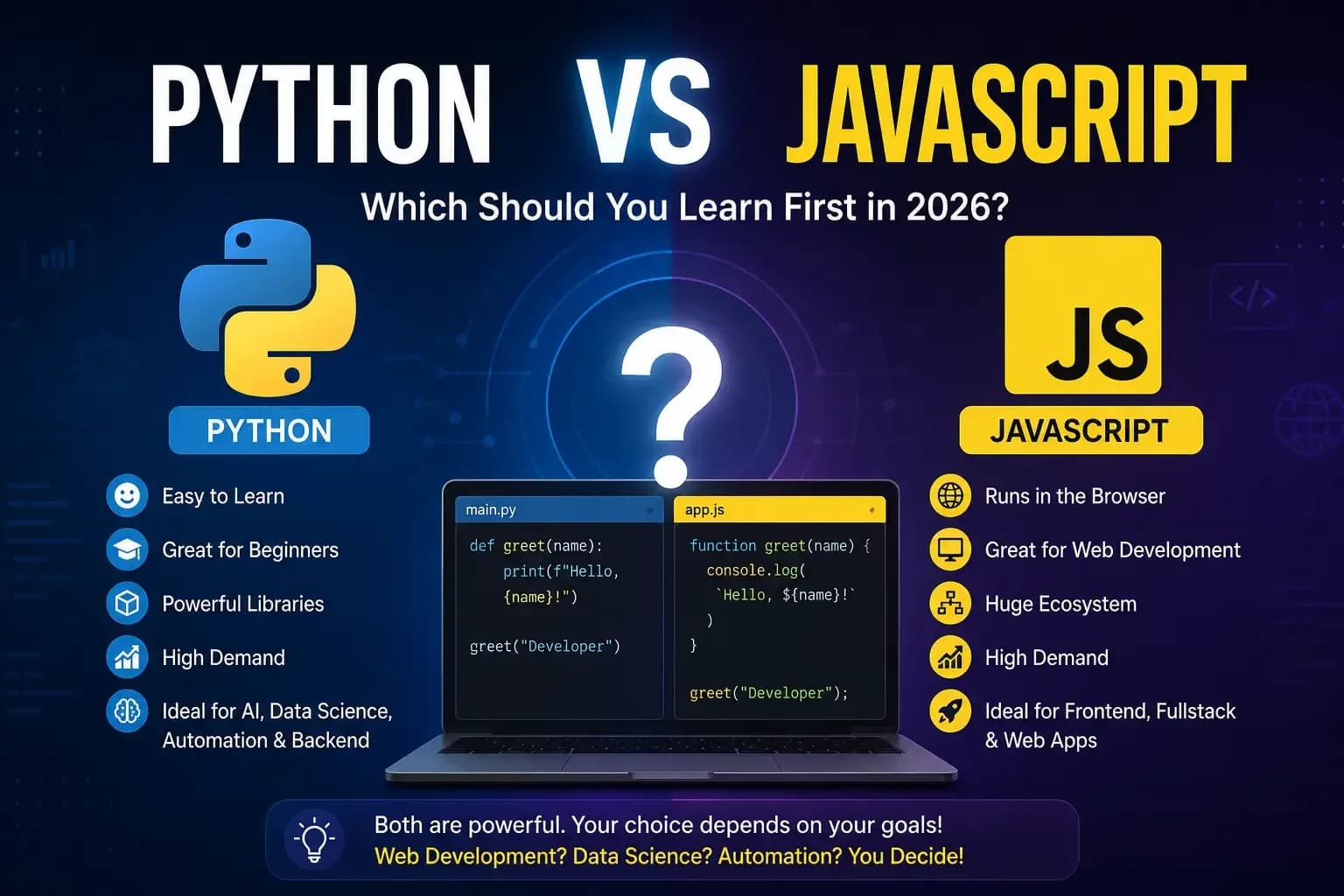
Learn Python first if you want the gentlest start, or you're aiming for data, AI, automation, or backend work. Learn JavaScript first if you want to build websites and web apps you can see in a browser, or you want the fastest path to freelance and web-development work. You can't really go "wrong" — both are excellent, in-demand, and beginner-friendly. Your goal decides the winner.
Python vs JavaScript at a glance
| Python | JavaScript | |
|---|---|---|
| Ease for beginners | Very easy, clean syntax | Easy, but a few quirks |
| Best for | Data, AI/ML, automation, backend | Websites, web apps, frontend, full-stack |
| Runs in the browser? | No | Yes (it powers the web) |
| See results visually? | Slower to "see" output | Instant — build a page and view it |
| Job demand | Very high (data/AI/backend) | Very high (web is everywhere) |
| Freelance-friendly | Good | Excellent (clients want websites) |
| Learning curve to first project | Short | Short |
Round 1: Which is easier to learn?
Winner: Python (just). Python reads almost like plain English. There are no curly braces or semicolons to trip over, and the code is clean and forgiving — which is why so many schools and universities teach it first. JavaScript is also beginner-friendly, but it has a few famous quirks (how it handles equality, this, and asynchronous code) that can confuse newcomers early on.
If your only goal is "learn to think like a programmer with the least friction," Python wins this round. Our Python for Beginners guide is a gentle place to begin.
Round 2: What can you actually build?
This is where they split completely.
Python is your tool for data analysis, machine learning and AI, automation scripts (automating boring tasks), web backends, and scientific computing. If you dream of working with data or AI, Python is basically the language of that world.
JavaScript is the language of the web. Every website you've ever used runs JavaScript. With it you can build websites, interactive web apps, mobile apps, and — with Node.js — backends too. It's the only language that runs natively in the browser, which makes it uniquely powerful for anything people see and click.
Winner: it's a tie — it depends on what you want to make. Want to see a real, clickable result fast? JavaScript. Want to crunch data or build AI? Python.
Round 3: Jobs, demand & money
Good news: both are among the most in-demand languages in the world, and both pay well. Python dominates data science, AI/ML and backend roles. JavaScript dominates web development — and since almost every business needs a website, the sheer volume of JavaScript work (including freelance) is enormous.
For freelancing and earning quickly, JavaScript often has the edge, simply because "build me a website" is the most common request a beginner can fulfil. We broke down where web skills sit among the best-paid options in 7 High-Income Skills to Learn in 2026.
Winner: tie for demand; slight edge to JavaScript for fast freelance income.
Round 4: Which grows with you?
Here's the thing serious developers know: you'll probably end up learning both. A data scientist picks up a little JavaScript to visualise results; a web developer picks up Python for automation and AI features. Whichever you start with, the second one is far easier because you already understand programming fundamentals.
If you go the JavaScript route, your natural next steps are frameworks and tools like React, Next.js and TypeScript — and you can see the full path in our Full Stack Web Developer Roadmap.
Choose Python first if…
- You want the absolute easiest start.
- You're excited about data, AI, or machine learning.
- You want to automate boring, repetitive tasks.
- You're studying and want a language that's common in classrooms and exams.
Choose JavaScript first if…
- You want to build websites and web apps you can see and share.
- You want the fastest route to freelance work and paying clients.
- You like instant, visual feedback while you learn.
- You eventually want to become a full-stack web developer.
Can you learn both?
Absolutely — and most good developers do. The smart move is to pick one, get genuinely comfortable with it (3–6 months), build a couple of real projects, then add the other. Learning two at once as a total beginner just slows you down. One at a time, all the way through, beats dabbling in five.
The verdict
There's no universal winner — there's a winner for you:
- Data, AI, automation, or the easiest possible start? → Python.
- Websites, web apps, fastest freelance income, visual learning? → JavaScript.
Whatever you pick, the biggest mistake is spending weeks choosing instead of starting. Both languages are fantastic, both are hugely in demand, and both will teach you to think like a programmer. Pick the one that matches your goal today, open a tutorial, and write your first line of code this week.
Not sure what else is worth learning this year? See our full breakdown in Best Programming Languages to Learn in 2026, and grab the free developer tools — JSON Formatter, Base64, Slug Generator and more — you'll use them the moment you start building.
_20260712_155541_rrkiok.webp&w=3840&q=75)
Join the conversation
No comments yet — be the first to share what you think.